Il secondo fronte della terapia: alimentazione e nutrizione nel paziente oncologico
Quando prendersi cura del tumore significa anche prendersi cura dell’organismo che lo sta affrontando
A cura del dott. Edoardo Gonzaga, veterinario nutrizionista, e del dott. Paolo Guazzi, veterinario oncologo
👉 scroll down for the full Englis version
Perché un articolo a quattro mani
Nel paziente oncologico la malattia non riguarda soltanto il tumore. Lavoriamo nella stessa realtà clinica e abbiamo imparato quanto sia importante confrontarci: la terapia oncologica può modificare le esigenze nutrizionali, e lo stato nutrizionale può influenzare il modo in cui il paziente affronta la malattia e le cure.
Dr Paolo Guazzi, oncologo. «In oltre vent’anni di osservazioni cliniche ho capito sempre meglio l’importanza della nutrizione: serve ad affrontare le terapie e ad avere le energie per contrastare il tumore. Non perdere massa muscolare, mantenere il desiderio di mangiare e conservare il corretto funzionamento dell’intestino può avere un’importanza pari a quella di una chemioterapia ben condotta.»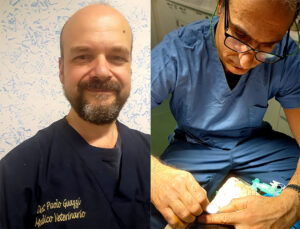
Il tumore non è il paziente
Dr Edoardo Gonzaga. Davanti a noi c’è un cane o un gatto che deve affrontare la malattia, eventuali patologie concomitanti e spesso terapie già in corso, soprattutto se ha più di 10 anni. Per questo la prima domanda non è «che cosa deve mangiare?», ma «di che cosa ha bisogno questo paziente, in questo momento?».
Nella valutazione osservo peso, condizione corporea, massa muscolare, appetito, eventuali disturbi gastrointestinali e terapie in corso. La bilancia da sola non basta: un animale può mantenere il peso e intanto perdere massa muscolare.
Un tumore può inoltre alterare il metabolismo, favorendo infiammazione e consumo dei tessuti, soprattutto muscolari. Insieme a inappetenza e nausea, questo può portare alla cachessia neoplastica. L’obiettivo non è semplicemente aumentare le calorie, ma mantenere il paziente nelle migliori condizioni nutrizionali possibili durante malattia e terapie.
Quando mangiare diventa difficile
Se un animale mangia meno, la domanda è «perché non sta mangiando?». Nausea, dolore, vomito, diarrea, alterazioni del gusto, stress o effetti delle terapie possono ridurre l’appetito, e prima di cambiare alimento bisogna correggere la causa. Sally, cane in chemioterapia, lasciava parte della razione nella ciotola: la famiglia pensava di cambiare cibo, ma il problema era la nausea da trattamento. Risolta quella, è tornato l’interesse per il pasto.
Un pasto saltato non è per forza un problema. Un animale che mangia progressivamente meno, invece, merita attenzione.
Dr Guazzi. «Il calo dell’appetito, spesso con nausea e vomito, può essere il primo segnale di tumori di fegato, pancreas, intestino e stomaco. In altri casi l’appetito c’è ma mangiare è impossibile, come nei tumori della bocca. O è il cibo a non essere riconosciuto: alcuni tumori del naso, soprattutto nel gatto, impediscono di percepirne l’odore.»
Cosa mettere nella ciotola
Dr Gonzaga. La risposta non è uguale per tutti. Energia e proteine vanno adeguate al singolo paziente, con attenzione alla massa muscolare; grassi, carboidrati e fibre si valutano nell’insieme della dieta e delle patologie concomitanti.
Gli omega-3 possono avere un ruolo in alcuni pazienti, ma non sono un «integratore anticancro». E il fatto che molte cellule tumorali consumino glucosio non significa che eliminare i carboidrati possa «affamare» il tumore. Non cerchiamo l’alimento miracoloso, ma un’alimentazione completa, equilibrata, appetibile e adatta a quel paziente e a quel momento del percorso.
Anche il microbiota intestinale può risentire di malattia, cambi di dieta, antibiotici e terapie, e merita attenzione quando compaiono diarrea o altri disturbi gastrointestinali. Le conoscenze però sono in evoluzione e non c’è evidenza che modificare la flora intestinale curi un tumore.
La «dieta anticancro»: cosa sappiamo e cosa no
Ad oggi non esiste una dieta universale che «affami» il tumore o sostituisca le terapie. Anche dove c’è un razionale biologico interessante, non è detto che migliori risposta alla cura o prognosi. Lo stesso vale per gli integratori: naturale non significa innocuo o utile, soprattutto in un animale che assume farmaci. La domanda giusta è «qual è l’alimentazione più adatta a questo paziente, con questa malattia e questa terapia?».
Dr Guazzi aggiunge alcune osservazioni dalla pratica:
- Alimentazione e organi chiave. La chemioterapia, per quanto ben tollerata, mette sotto stress fegato, reni e intestino. Intervenire dalla base alimentare per preservarli aiuta il paziente e anche il proprietario, che altrimenti gestirebbe ogni giorno una lunga lista di capsule, compresse e polveri.
- Bocconi per i farmaci. Wurstel, burro, formaggi o pane usati per somministrare le medicine spesso peggiorano le condizioni dell’intestino.
- Dieta casalinga fai-da-te. Sempre più proprietari, dopo la diagnosi, sostituiscono l’alimentazione commerciale con una casalinga senza guida veterinaria, tra social e intelligenza artificiale. Cani e gatti non sono «esseri umani con la pelliccia»: definire il cane semplicemente «onnivoro» è fuorviante, perché dimentica il suo passato di predatore. Rispettare il fabbisogno di proteine e grassi animali, con carboidrati facilmente digeribili e poche fibre e vegetali crudi, è spesso molto importante.
- Dieta chetogenica. Si dice che i corpi chetonici «affamino» il tumore, ma esistono molti tipi di tumore, non tutti dipendenti dal glucosio, e le evidenze principali vengono da studi di laboratorio. Non esiste ancora una prova definitiva, né in medicina umana né, tanto meno, veterinaria.
Un piano che cambia con il paziente
Dr Gonzaga. Non parto da una dieta già pronta, ma dal paziente. Se arriva con una dieta perfetta sulla carta ma la mangia solo in parte, o ha nausea dopo i pasti, quella dieta non sta funzionando: bisogna capire che cosa possiamo realisticamente fargli mangiare, mantenendo un’alimentazione il più possibile completa. La scelta tra alimentazione commerciale, casalinga o cruda non si fa per principio, ma valutando completezza, sicurezza microbiologica, appetibilità e condizioni individuali. Peso, massa muscolare, appetito e tolleranza vengono poi rivalutati nel tempo.
Una medicina integrata
Nel paziente oncologico non cerchiamo una dieta miracolosa, ma di metterlo nelle migliori condizioni nutrizionali per affrontare malattia e terapie, preservandone la qualità di vita. La nutrizione non è un’alternativa alla terapia né una cura: è parte integrante della presa in carico. L’oncologo diagnostica e tratta la malattia, il nutrizionista valuta e sostiene lo stato nutrizionale. Non due percorsi paralleli, ma due punti di vista che si incontrano.
Perché il tumore è la malattia da trattare, ma il paziente è chi dobbiamo curare.
Come contattarci
Dott. Edoardo Gonzaga, veterinario nutrizionista (Master II livello Nutrizione e Alimentazione Clinica). Email: info@veterinariogonzaga.it, tel. 349 2309408. Esercita a Livorno, Pisa e presso la Clinica Veterinaria Polispecialistica Russi (RA).
Dott. Paolo Guazzi, veterinario oncologo (GP Cert Oncologia). Email: paologuazzi@gmail.com. Esercita a Modena e presso la Clinica Veterinaria Polispecialistica Russi (RA).
Estratto dall’articolo pubblicato sulla rivista Il Centro ( gennaio 2027).
The Second Front of Therapy: Nutrition in the Cancer Patient
When caring for the tumor also means caring for the body that is facing it
By Dr. Edoardo Gonzaga, veterinary nutritionist, and Dr. Paolo Guazzi, veterinary oncologist
This is an excerpt from the article published in Il Centro [Jan 2027].
Why a joint article
In the cancer patient, the disease is not only about the tumor. We work in the same clinical setting and have learned how important it is to consult each other: cancer therapy can change nutritional needs, and nutritional status can influence how the patient copes with the disease and its treatments.
Dr. Paolo Guazzi, oncologist. “After more than twenty years of clinical observation, I have come to understand ever more clearly the importance of nutrition: it helps patients get through treatment and gives them the energy to fight the tumor. Not losing muscle mass, keeping the desire to eat and preserving proper bowel function can be as important as a well-managed course of chemotherapy.”
The tumor is not the patient
Dr. Edoardo Gonzaga. In front of us is a dog or a cat who must face the disease, any concurrent conditions and often treatments already underway, especially if over 10 years old. That is why the first question should not be “What should it eat?” but “What does this patient need, right now?”
In my assessment I look at weight, body condition, muscle mass, appetite, any gastrointestinal problems and current therapies. The scale alone is not enough: an animal can keep its weight while losing muscle mass.
A tumor can also alter metabolism, promoting inflammation and tissue breakdown, especially of muscle. Together with loss of appetite and nausea, this can lead to cancer cachexia. The goal is not simply to increase calories, but to keep the patient in the best possible nutritional condition during illness and treatment.
When eating becomes difficult
If an animal eats less, the question is “Why isn’t it eating?” Nausea, pain, vomiting, diarrhea, changes in taste, stress or the effects of treatment can all reduce appetite, and the cause should be addressed before changing the food. Sally, a dog undergoing chemotherapy, began leaving part of her meal in the bowl. Her family thought it was time to switch foods, but the real problem was nausea caused by the treatment. Once that was dealt with, her interest in food returned.
A skipped meal is not necessarily a problem. An animal that eats progressively less, however, deserves attention.
Dr. Guazzi. “Reduced appetite, often with nausea and vomiting, can be the first sign of tumors of the liver, pancreas, intestine and stomach. In other cases the appetite is there but eating is impossible, as with tumors of the mouth. Or the food is simply not recognized: some nasal tumors, especially in cats, prevent the animal from smelling it.”
What goes in the bowl
The answer is not the same for everyone. Energy and protein must be tailored to the individual patient, with attention to muscle mass; fats, carbohydrates and fiber are assessed within the overall diet and any concurrent conditions.
Omega-3 fatty acids may play a role in some patients, but they are not an “anticancer supplement.” And the fact that many tumor cells consume a lot of glucose does not mean that eliminating carbohydrates can “starve” the tumor. We are not looking for a miracle food, but for a complete, balanced, palatable diet suited to that patient and that stage of the journey.
The gut microbiota can also be affected by the disease, dietary changes, antibiotics and treatments, and deserves attention when diarrhea or other gastrointestinal problems appear. Knowledge in this area is still evolving, however, and there is no evidence that modifying the gut flora can cure a tumor.
The “anticancer diet”: what we know and what we don’t
To date, there is no universal diet that “starves” the tumor or replaces treatment. Even where there is an interesting biological rationale, it does not necessarily improve response to therapy or prognosis. The same goes for supplements: natural does not mean harmless or useful, especially in an animal taking medication. The right question is “What is the most suitable diet for this patient, with this disease and this treatment?”
Dr. Guazzi adds a few observations from practice:
- Nutrition and key organs. Chemotherapy, however well tolerated, puts stress on the liver, kidneys and intestine. Working on the dietary foundation to protect them helps the patient, and also the owner, who would otherwise have to manage a long daily list of capsules, tablets and powders.
- Treats used to give medication. Hot dogs, butter, cheese or bread used to hide medicines often make the intestine worse.
- DIY home-cooked diets. More and more owners, after the diagnosis, replace commercial food with a home-cooked diet without veterinary guidance, relying on social media and artificial intelligence. Dogs and cats are not “humans in fur coats”: calling the dog simply “omnivorous” is misleading, because it overlooks its predatory ancestry. Meeting the need for animal protein and fat, with easily digestible carbohydrates and limited fiber and raw vegetables, is often very important.
- The ketogenic diet. It is said that ketone bodies “starve” the tumor, but there are many types of tumor, not all dependent on glucose, and the main evidence comes from laboratory studies. There is still no definitive proof, either in human or, even less, in veterinary medicine.
A plan that changes with the patient
Dr. Gonzaga. I do not start from a ready-made diet, but from the patient. If an animal arrives with a diet that looks perfect on paper but eats only part of it, or feels nauseous after meals, that diet is not working: we need to work out what we can realistically get the patient to eat, while keeping the diet as complete as possible. The choice between commercial, home-cooked or raw feeding is not made on principle, but by weighing completeness, microbiological safety, palatability and individual conditions. Weight, muscle mass, appetite and tolerance are then reassessed over time.
Integrated medicine
In the cancer patient we are not looking for a miracle diet, but for ways to put the animal in the best nutritional condition to face the disease and its treatments, while preserving quality of life. Nutrition is not an alternative to therapy, nor a cure: it is an integral part of care. The oncologist diagnoses and treats the disease, the nutritionist assesses and supports nutritional status. Not two parallel paths, but two points of view that meet.
Because the tumor is the disease to be treated, but the patient is the one we must care for.
Contact us
Dr. Edoardo Gonzaga, veterinary nutritionist (Level II Master’s in Clinical Nutrition and Feeding). Email: info@veterinariogonzaga.it, tel. +39 349 2309408. Practices in Livorno, Pisa and at the Clinica Veterinaria Polispecialistica Russi (RA).
Dr. Paolo Guazzi, veterinary oncologist (GP Cert in Oncology). Email: paologuazzi@gmail.com. Practices in Modena and at the Clinica Veterinaria Polispecialistica Russi (RA).
Excerpt from the article published in Il Centro, [Jan 2027].